

The "scrappy" museum ethos, once a celebrated hallmark of the cultural sector, has reached a point of diminishing returns. For years, institutions addressed emerging needs by layering individual digital tools on top of one another. Need a better ticketing system? Buy one. Need a specialized gift shop POS or a gala registration page? Add another.
This tactical approach has resulted in a Franken-stack: a fragmented collection of point solutions that operate in isolation. While these tools may solve immediate problems, they collectively represent a strategic failure. As visitors and patrons increasingly expect the seamless, personalized experiences common in the commercial sector, a disconnected tech stack has become a primary barrier to institutional growth.
The Human Capital Drain of Manual Data Management
The true cost of a museum's software stack resides in the human labor required to maintain it. When systems do not communicate natively, staff members across admissions, membership, and development spend a disproportionate amount of their time performing manual data reconciliation.
Recent 2025 sector benchmarks indicate that employees in organizations with fragmented systems spend approximately 25% of their work week on administrative data hygiene, deduplicating visitor records, manually importing CSV files from ticketing platforms, and correcting sync errors. This systemic inefficiency contributes directly to the high rates of staff burnout and turnover highlighted in the Nonprofit HR Talent Management Survey.
Institutions are effectively paying leadership-level salaries for clerical data entry. For a Membership Director earning $90,000, that translates to over $22,000 in annual lost productivity. This hidden tax siphons resources away from mission-critical work like exhibit curation, educational programming, and major gift cultivation.
Digital Amnesia and the Collapse of Member Retention
Member and donor retention remains the most pressing challenge for the modern museum. According to recent reports, retention rates consistently struggle to break the 45% mark. In the museum context, much of this churn is attributable to digital amnesia, a direct byproduct of point solutions.
When a CRM cannot see real-time data from the admissions desk, the gift shop, or an event platform, the institution loses the ability to recognize a supporter’s full history. A long-time member who has just purchased four tickets for a special exhibit might receive a generic "Visit Us Soon" marketing email the following morning. Worse, a major donor may stand at the admissions desk and be treated as a total stranger because the ticketing system isn't synced with the donor database.
This lack of context damages the patron relationship. Retention relies on personalization, and personalization requires a unified data set. Fragmented systems prevent museums from seeing the full visitor journey, making it impossible to deliver the timely, relevant communications that convert one-time visitors into lifelong members.
Masking the "Super-User" and the Cost of Siloed Touchpoints
Museums and cultural institutions face an even more acute version of the point-solution crisis. A single individual often interacts with a museum across multiple distinct touchpoints: admissions, the gift shop, membership renewals, educational events, and more.
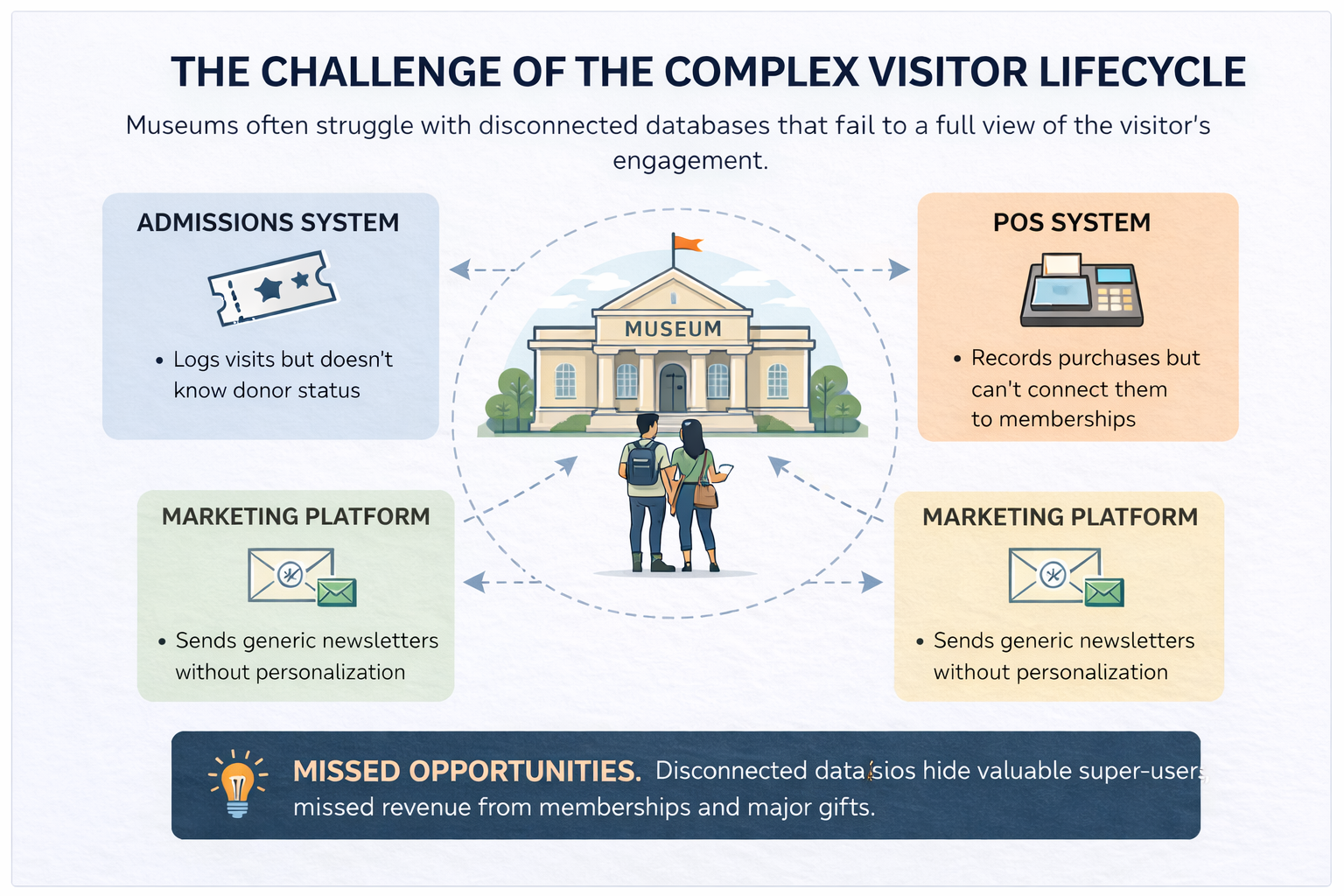
In a traditional point-solution environment, these interactions are captured in isolated databases:
- ➡️The Admissions System logs the visit but knows nothing of the visitor’s donor status.
- ➡️ The POS System records a purchase in the café or shop without linking it to a membership profile.
- ➡️ The Marketing Platform sends generic newsletters because it lacks data on which exhibits the visitor actually attended.
This fragmentation masks the presence of super-users or the visitor who attends three times a year. That person spends $100 in the gift shop is a prime candidate for a high-level membership or a major gift. However, when these data points live in separate silos, the museum misses the opportunity to identify and nurture these high-value relationships. The cost of a point solution is the lost revenue from the memberships that were never offered.
The 2026 AI Divide - Clean Data as Infrastructure
As of 2026, the divide between thriving cultural institutions and those struggling to survive is defined by data maturity. The current generation of AI-driven predictive tools, capable of identifying members at risk of churning or suggesting optimal gift amounts based on visit frequency, requires a single source of truth to function.
AI cannot analyze data it cannot access. If a museum's data is spread across five different platforms, it remains "dark data," unstructured, inaccessible, and useless for predictive modeling. Unified platforms provide the clean, centralized data architecture necessary to leverage these technological advances. A fragmented stack is a structural ceiling that prevents an institution from adopting the very tools designed to increase its efficiency and reach.
Shifting to an Ecosystem Mindset
Strategic growth requires a shift away from buying tools toward building ecosystems. This transition involves prioritizing a central database that serves as the single source of truth for every department, from front-of-house admissions to back-of-house development.
Unified ecosystems eliminate the need for brittle, third-party integrations that frequently fail during high-traffic exhibit launches. They provide real-time reporting that allows leadership to make decisions based on current visitor performance rather than weeks-old data exports.
While the initial cost of a platform migration often exceeds the price of a standalone app, the long-term ROI is found in recovered staff time, increased member retention, and the ability to scale without adding administrative overhead. To fulfill their missions in a high-tech landscape, museums must retire the Franken-stack and invest in a foundation that supports the future of their work.