

Your Data Disaster Started Years Ago
Another work day, another frustration. Your marketing lead sends a membership appeal to someone who renewed yesterday. Ticketing shows 847 first-time visitors last month, but the CRM only has 200 of them. Your development lead can't tell you which board member attended the gala because their RSVP lives in a different database.
How You Got Here (And Why It Keeps Getting Worse)
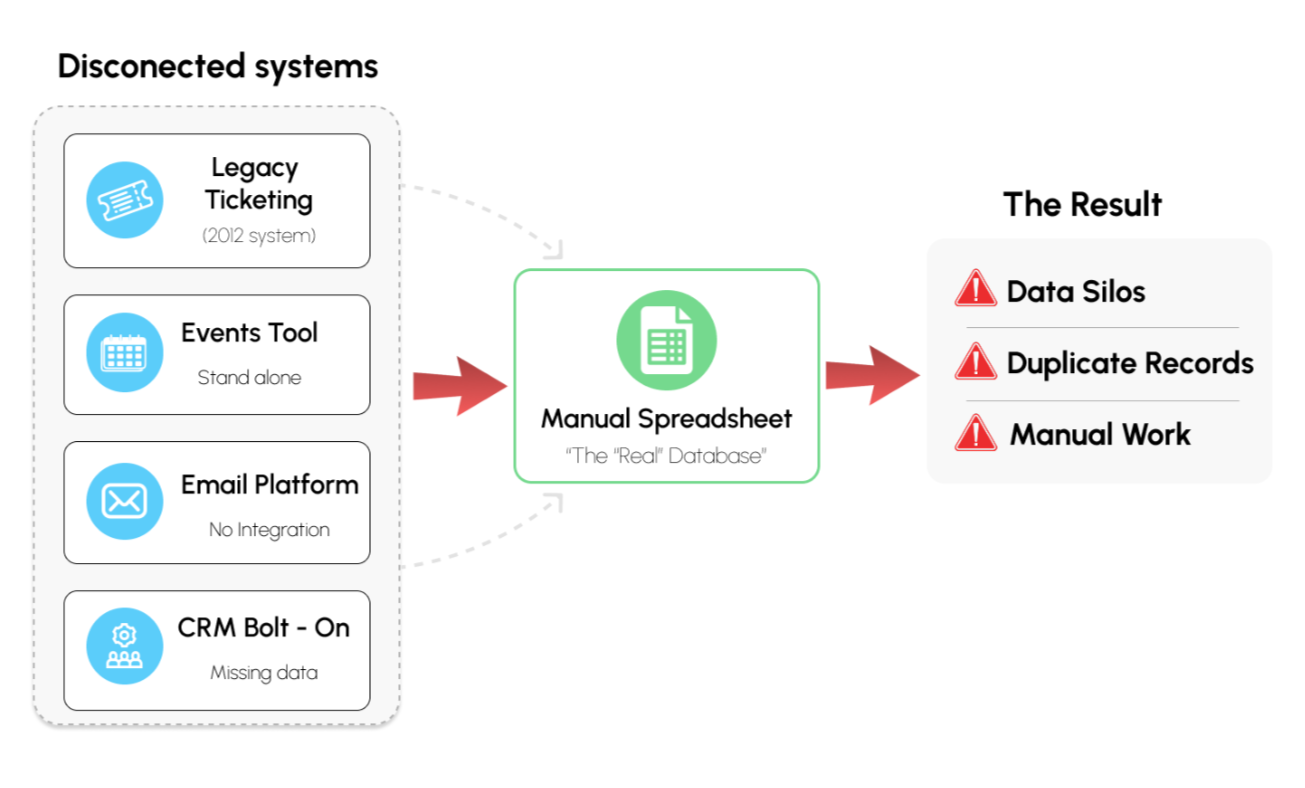
Conduct a typical archaeology dig of museum tech, and you'll likely find:
- ✅ Ticketing system from 2012 that runs on hope
- ✅ CRM bolt-on that nobody trained the new hire on
- ✅ Email platform the former communications director chose in a panic
- ✅ Event management tool that seemed "fine at the time"
- ✅ Six spreadsheets serving as the "real" database
- Each tool works, but nothing connects, and every handoff loses data. As tools evolve, staff turns over, and initiatives shift, the technology gets more siloed. The result: duplicate records, ghost donors, emails to the wrong segment, and reports that contradict each other.
What does this mean for you and your team? The ripple effects you’re experiencing include duplicate records, ghost donors, emails to the wrong segment, and reports that contradict each other.
What This Actually Costs You
Development wastes full work weeks per quarter cleaning duplicate records. Your first-time visitor → member conversion rate barely registers because nobody follows up automatically. Communications send conflicting emails to major donors in one week. Staff turnover rises because "nothing works and nobody will fix it."
When the status quo isn't stable, it's expensive and demoralizing. And it only gets worse as tools become less connected and silos form.
One museum professional on Reddit said even the supposed all‑in‑one platforms (like big suite ticketing/CRM systems) still leave them stitching together donor management, marketing, memberships, and events. They end up hunting for tools with open APIs to glue everything back into a real CRM “hub” because the original stack boxed them in.
Let’s face it. You don’t want your museum dragged on the internet by your visitors, members, staff, or volunteers.
What Working Systems Actually Look Like
Someone buys a ticket → they're in your CRM → they get a welcome email → two weeks later, they're invited to member night → they join → their record updates everywhere at once.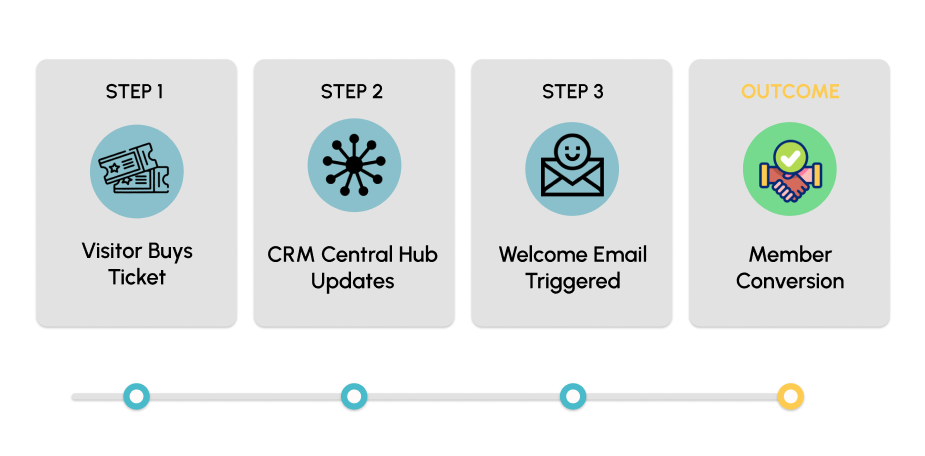
Beautiful, right? No manual export. No spreadsheet. No "did anyone capture this person?" When systems talk to each other, you can actually steward people instead of just tracking them.
One 2025 industry summary notes that nearly 8 in 10 museums now use visitor data analytics to understand audiences and inform decisions. Institutions that can't trust their data or extract it from siloed systems are competing with one hand tied behind their back.
You Don't Have to Rip Everything Out
The objections are predictable:
- ❌ We can’t rip and replace all of our technology.
- ❌ We have so much legacy data.
- ❌ Our technology has so many connections.
- ❌ It will take too long to learn a new system.
- ❌ I’m worried about process change.
- ❌ Moving systems will affect our constituents.
- ❌ I know this is important for me to do my job well (as a marketer), but I have to get every other department on board.
- ❌ Betty loves our current system, regardless of the fact that she spends 10 hours a week reconciling data.
Here's the reality: modernization isn't scorched earth. Work in phases. Start with your biggest bottleneck. Connect two systems, clean one dataset, or build one real-time dashboard.
A typical successful roadmap:
- ✔️ Audit what you actually use (versus what you're paying for)
- ✔️ Map where data gets lost or duplicated
- ✔️ Connect the most critical handoffs first
- ✔️ Train people on the new workflows
- ✔️ Build dashboards that actually answer your questions
Change may not seem easy, but as Benjamin Franklin observed, "When you're finished changing, you're finished."
Why You Need a Partner (Not Another Vendor)
Museums don't have data engineers on staff and shouldn't need them. Your expertise is collections care, interpretation, and visitor experience. When solving bad tech, look beyond "just another vendor".
Find a trusted partner who:
- ✔️ Understands nonprofit constraints and timelines
- ✔️ Speaks your language, not just database jargon
- ✔️ Migrates data without wrecking operations
- ✔️ Trains your team, not just installs software
- ✔️ Sticks around when something breaks
- ✔️ Scopes solutions and builds roadmaps before taking your money
- ✔️ Gets in the trenches learning your current processes
Museum professionals are brilliant at collections care, interpretation, and visitor experience. That's where your expertise belongs as an organization. You could spend three years learning the hard way, burning through staff goodwill and budget. Or bring in someone who's already made those mistakes and get it right in three months.
Schedule a FREE audit. Let's build you a tech stack that actually serves your mission..