

At 2:15 PM, a visitor purchases a family pass for your upcoming exhibit.
At 2:16 PM, they leave your website.
The transaction is complete, but the relationship has already gone dark.
Nearly 78% of museums now use data analytics to study visitor behavior but many still lack the integrated systems needed to connect online ticketing data directly into a unified CRM.
The money lands in your bank account, and the PDF ticket lands in the visitor's inbox. But in your CRM, silence. The Development Director doesn't know a potential member just engaged. The Shop Manager doesn't know this family also abandoned a cart full of merchandise.
The visitor is technically "coming," but digitally, they are invisible.
This is the hidden friction of museum e-commerce. Museums have become very good at selling tickets online, but very bad at remembering the people who bought them.
The Scale of the Missed Opportunity
Online ticketing has become standard infrastructure for museums. The global online event ticketing market, including museums and other attractions, was valued at more than $55 billion in 2022 and is projected to reach $90 billion by 2030. That scale reflects how normal it has become for visitors to plan visits, purchase tickets, and make additional purchases from their phones before they ever step through the door.
What followed that shift was a quiet buildup of data that most museums were not prepared to manage as a whole.
Ticketing platforms were adopted to handle volume. They shortened lines, enforced timed entry, and brought stability to daily attendance. Those systems worked as intended, but they were rarely designed to track long-term relationships. As digital sales increased, transactions began to pile up across ticketing tools, e-commerce platforms, and program systems, each capturing activity in isolation.
The result is a growing collection of accurate records that do not easily connect. A ticket buyer appears in the CRM without context. A member purchasing merchandise looks unrelated to their membership history. A donor who attends multiple paid programs blends into the same category as a first-time visitor. Each interaction is logged, but the sequence between them is lost.
Over time, teams adapt to this fragmentation. Marketing reviews campaign performance. Development focuses on giving history. Visitor Services monitors attendance. Each view reflects real data, but none of them shows how a person moves through the museum over months or years.
What accumulates is a detailed transaction trail without a reliable relationship trail. Museums generate more digital activity every year while losing sight of how those actions connect to the people behind them.
The Problem With "Add-On" Architecture
The typical museum tech stack grows by accident. You buy a ticketing platform. Then you add a Shopify store. Then a donation plugin. Each tool does its job, but none of them talk to each other.
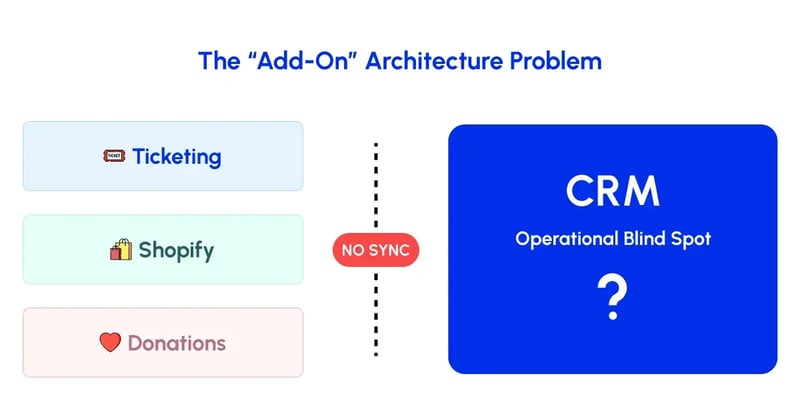
When your e-commerce and ticketing live outside your CRM, you create operational blind spots. Staff cannot answer simple questions like:
- How many ticket buyers became members within 30 days?
- Which exhibitions drive the most online merchandise sales?
- Did our major donor attend the paid workshop last week?
The answers exist, but they are trapped in isolated dashboards. To get them, your team has to manually export CSVs, wrestle with spreadsheets, and hope the data is clean. This isn't just annoying; it is an operational tax that slows down decision-making.
What Happens When the Data Connects?
When ticketing, e-commerce, and programs connect directly to a CRM through MuseumHub, the transaction stops being an endpoint. It becomes the beginning of a usable visitor record that carries forward across systems and teams.
MuseumHub is built on top of HubSpot and extends it with museum-specific structure. Timed entry, group tickets, memberships, donations, shop purchases, and program attendance all write back to the same visitor profile, using a CRM foundation that teams already rely on. The result is a single operating layer that reflects how museums actually work.
Centralized Visitor Context
Instead of managing disconnected lists, staff work from a shared visitor record. A ticket sale syncs automatically to the contact profile, alongside marketing engagement, prior visits, membership status, and shop activity. Over time, the timeline fills in naturally. You can see when someone opened an email, purchased tickets, attended an event, and made a follow-up purchase, without stitching together reports from multiple tools.
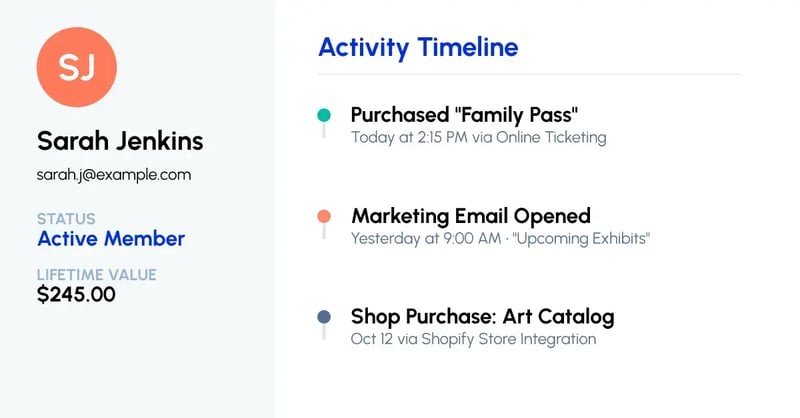
MuseumHub ensures that this data stays structured in a way that makes sense for museums, so education programs, exhibitions, and memberships do not collapse into generic fields.
Follow-Ups That Reflect Real Behavior
Most museums rely on broad follow-ups because they lack reliable signals. MuseumHub changes that by making visitor actions visible and actionable inside the CRM.
A visitor who buys tickets to a specific exhibition can receive a follow-up tied to that experience, such as a catalog offer or a related program invitation. Someone who attends multiple events over the year can be flagged for a membership outreach that reflects their actual engagement, rather than a generic campaign sent to everyone on a list.
These follow-ups are not built around assumptions. They respond to what visitors already did.
Revenue and Engagement in the Same View
Attendance numbers alone do not explain performance. With MuseumHub feeding clean data into HubSpot, reporting shifts from counting visits to understanding outcomes.
Teams can see which campaigns led to ticket sales, which programs drive repeat visits, and how events contribute to memberships or donations over time. Marketing, Development, and Visitor Services work from the same numbers, reducing reconciliation and making trade-offs clearer when budgets are reviewed.
MuseumHub keeps revenue and engagement connected, rather than forcing teams to choose between the two.
Museums process thousands of transactions, yet staff still spend too much time piecing together what those actions actually mean.
When ticketing, e-commerce, and programs connect through MuseumHub, staff stop stitching together reports after the fact. Visitor activity shows up where it belongs, inside the CRM, with enough context to act on it while it still matters. Follow-ups reflect real behavior. Reporting answers practical questions. Mondays start with clarity instead of cleanup.
If you want to see what that looks like in practice, we can walk through how MuseumHub sits on top of HubSpot to connect ticketing, online sales, and visitor engagement into one working system.